Showing posts with label Phattie Bike. Show all posts

Wednesday, January 28, 2015

Christmas Valley Sand Dunes - Fatbiking Pix 2


Tuesday, January 27, 2015

Christmas Valley Sand Dunes - Fatbiking

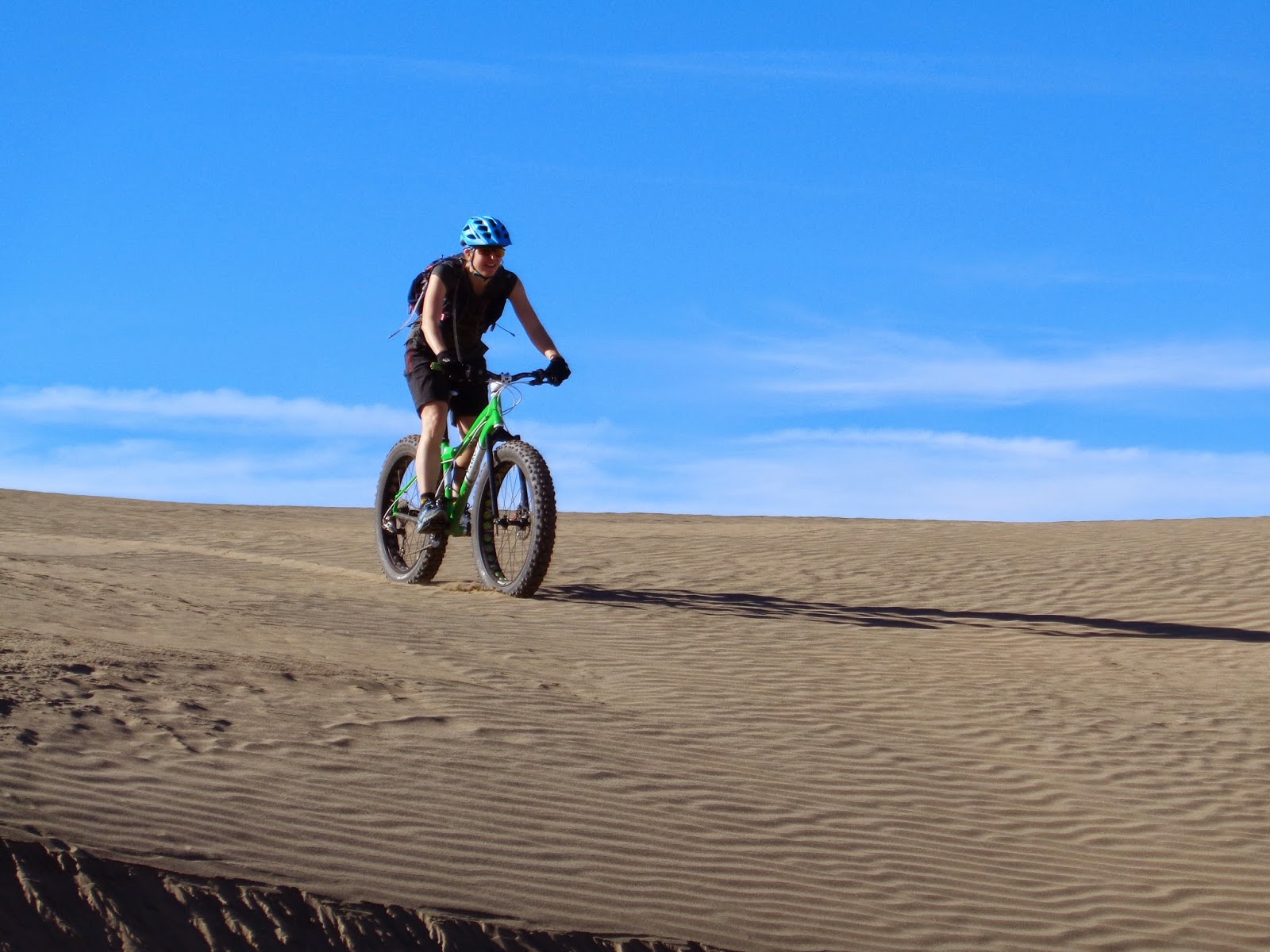
The unusually warm weather held through Sunday which meant there were outside the box opportunities for this time of year.  Christmas Valley Sand Dunes are east of Fort Rock in Oregon and as per the website are the largest shifting inland sand dunes in the state.  The dunes were created way back in the day when Mt Mazama blew her lid (creating Crater Lake).  The sand dunes are the pumice and ash from said explosion.

Another intriguing reason to go was the Lost Forest.  The lost forest is a little 'forest'...although forest is probably a bit of an exaggeration as it is not a 'thick' forest but more like a series of scattered ponderosa pines in an area that outwardly appears to have no water source.

Despite the geologic intrigue, the real reason was to get out there and dust off the fat bikes!  This time of year, the fatties are usually getting some mileage in the white stuff.  This was a little window to get out and play in the loose stuff.

After a 2 hour drive we got to the recreation area and were pleasantly surprised by how comfortable the temps were.  It was shorts weather!  and in January no less.

We quickly found one of the access roads to the dunes and saw that it was a giant mud-fest for a couple hundred feet.  The fatties handled the mud although it was that horrible clay mud that just stuck to everything.  The wheels and drivetrain quickly caked up and we did a little house-cleaning after we got through the bog.  Shortly after, we hit the dunes and had ear to ear grins on our mugs.  After riding for about 15 minutes, we stopped, took some pix, and deflated tires to around 4-5 psi.  This made a significant different in handling in the sand and made the riding just a little less challenging than it was before.

We spent a little over an hour pedaling though the dunes and kept having the pinch me moments of how it felt 'hot' in January, shortly followed up by....'where are we'!

What a great destination for a different kind of fat biking (different for us that is).  It would be fun to go back and do a little more exploring but it will definitely have to be during similar temperatures as I cannot fathom being out there in weather much warmer than what we were in.

Some pictures:


Thursday, February 14, 2013

Tubeless Fatty - Take 1

One of the appeals of going with the UMA rims was that the word on the street was the rims played nice with going tubeless.

The big reason for tubeless is that the tubes on these fat bikes are heavy, and in all the wrong places:  rotational weight.  The further out the weight is on the circumference of wheel, the 'heavier' the bike feels.  The Surly tubes run close to a pound a piece!

I got some 90mm stans tape from Fatback and took a shot at setting the front tire up as tubeless.  The big challenge with a tubeless set up on fat bike rims is having a tight enough seal to inflate the tires.

I tried inflating the tires after installing the stan's tape and sure enough, air was escaping as quickly as it was entering.  I then added a light layer of the blue foam sill tape to build up the middle of the rim and that was enough to create a tight enough seal for the tire to inflate.

I inflated the tire to about 35 psi in order for the tire beads to seat properly on the rim and then promptly deflated the tire so I could put in Stan's sealant.  After a quick injection of Stan's, it was time to re-inflate and seal up any leaks.  I brushed soapy water on the tire and rotated the wheel to the leaks and jiggled the wheel back and forth until the Stan's sealed up those areas....I did the wheel dance (wheel jiggle) as I worked my war around the wheel/tire and left it for 30 minutes to sit on one side, and then flipped the tire over to the other side...fast forward a couple of weeks and it is still holding air....

Success!!

Process went sorta' like this:
Rubbing alcohol to wipe off any grime....

90mm wide Stan's tape:
Roll it on tight!
Find valve hole and puncture through tape:
Install sill tape to increase 'volume' for tire to bead
Put tire back on and wipe sidewalls with soapy water (help for tires to 'slip' on and bead better)
inflate to bead the tire on the rim (inflate to around 30-25 psi)
Inject some Stan's

Re-inflate and let sit to see if it holds air....work Stan's to places where soapy water is bubbling and move tire around so that Stan's plugs up the escape hole...

Thursday, January 17, 2013

Phattie Snowcabulary

I always wondered about the legitimacy of the old adage that eskimos had 100 different words for snow...after spending a little more time in the white stuff, I am starting to understand the feasibility of that seemingly outlandish old wives' tale....

Being in the backcountry makes you start to pay attention to the snow and its personalities...and yes ohh yes it seems to suffer from many 'Faces of Snow'.

As a snow biker, I have come up with some snow types and my own personal lingo...

  • light n fluffy - all good as long as it is less than 7 inches on hard pack
  • Hail and Marbles - hard to ride in due to getting pelted - 
  • NW cement - heavy, soft, wet and hard to ride through
  • Ice-capades - sudden turns can put a bike and rider on their path to a yard sale
  • Hard n' Crispy - nice and fast!  Ideal conditions for fast rolling bikes...sometimes from a warm up and then a freeze overnight.  
  • El Slushee - warm, wet, and slow....painful to ride in...avoid the flailing....
  • Corduroy Bliss - groomed and packed, Thank you Groomers!
  • Faux Corduroy - it looks like it has been groomed but it is just the tope layer and it is thin and not sturdy enough to support snow tires
  • Snowshoe Pack - a good start for additional pack by fat tires
  • Fatty Pack - ahhh - just perfect...when trail has been packed down by bikers - nice n smooth eh - follow the 4 inch wide tread patterns
  • Singletrack Bliss - Packed by all user groups...usually about 18 inches or so wide of pack and then deep and soft as soon as you head off the packed goods
  • SnoMo - snow that looks like it should be packed from the SnoMo's but it is actually loose and hard to ride on
  • AutoPack - follow the auto tire tracks - nice and packed down!
  • Critter Pack - follow the critter postholes
  • Fresh Tracks - ahhh, looking back to see your first tracks on the white stuff'
  • Dry Tracks - yup yup, you can ride these bad boys on the dirt too!

Tuesday, January 15, 2013

Fat BIke Best Practices - IMBA

as taken from IMBA's website:


Fat Bike Best Practices

Yield triangle design by Jake Hawkes/Grand Targhee Resort.

Regarding equipment, what is the bare minimum I need to ride on snow?

  1. Wide tires — deep snow coverage often requires tires wider than 3.5 inches
  2. Tire pressure will usually be less than 10 PSI
  3. You will not leave a rut deeper than one inch in the snow
  4. You are able to safely control your bike and ride in a straight line
  5. You have permission to ride from the land manager

DO NOT RIDE, especially on groomed nordic and snowmobile trails, if you can't meet all of the requirements above.

Best Practices for Riding on Nordic Trails

  • Only ride at ski areas that allow and encourage biking.
  • Yield to all other users when riding. Skiers don't have brakes but you do!
  • Ride on the firmest part of the track.
  • Do not ride on or in the classic tracks.
  • Leave room for skiers to pass (don't ride side-by-side with all of your buddies blocking the full trail).
  • Allow the track time to set up after grooming and before riding.
  • Beware of alternative days for bikes and for skiers.
  • ONLY ride a purpose-built fat bike, not any old mountain bike. Tire tread must be wider than 3.7 inches.
  • Be an ambassador for the sport: stay polite, educate other riders, discourage bad behavior and follow the rules.
  • Help out and get involved by joining your local nordic club.
  • Donate money for trail grooming.

Best Practices for Riding on Snowmobile Trails

  • When riding on snowmobile trails, use a front white blinker and rear red blinker at all times. Wear reflective material on both the front and rear of your body.
  • Stay to the far right of the trail and yield to snowmobiles.
  • Know and obey the rules of your local land manager. Understand that some trails may be on private property and might not be open to alternative uses.
  • Be prepared. Winter travel in the backcountry requires carrying proper gear and dressing properly. Be self-sufficient!
  • Use extreme caution when riding at night. Be visible and always use lights.
  • Be friendly! Fat bikers are the newest users and the snowmobilers you encounter might not be welcoming. Be courteous and open to suggestions.
  • Help out by supporting your local snowmobile club.
  • Donate to trail grooming and maintenance efforts.

Best Practices for Riding on Natural Terrain and in the Backcountry

In the right conditions, a fat bike can be the ultimate winter backcountry travel tool. Frozen conditions and minimal snow coverage (1-5 inches) means access to areas that are impassible during the warmer months. But just because you can ride somewhere doesn't mean you should. Be aware and be prepared.
  • Do not trespass! Know whether or not you are on private property. Obey ALL land manager rules. Some land parcels are closed to bikes whether you are riding on a trail or not.
  • Do not ride through sensitive wildlife habitats. This may be especially important on beaches or in places where animals hibernate. Learn about the area you want to ride in before you ride there.
  • Do not disturb wildlife. Many species survive on minimal diets during winter. Stressors or the need to move quickly can deplete their energy stores.
  • Learn safe ice travel. Riding on frozen water can be extremely dangerous. Is the ice thick enough to support you? Take ice fishing picks and a length of rope when riding on lakes and rivers.
  • Understand changing conditions. New snowfall or warming temperatures can make the return trip much more difficult. Tire tracks can be covered, hard snow can turn to slush, rivers can start to melt. Always know the forecast and be aware of how changing conditions might alter the safe passage of your route.
  • Be prepared. Carry provisions in case you have to stay out longer than planned.
  • Let people know. Make sure someone else knows where you are going, when you left and when you expect to return.
  • Learn to share. Be aware that your tracks might attract other riders. Understand that "your" route might not remain a secret for long.

Monday, January 14, 2013

Dutchman Sno Park Fat Biking

The morning chill still hovered in the air as I made my way up to Dutchman for the fatbike ride.  It was in the low single digits for temps and it was bound to be a wee bit chilly until the body warmed up and started to create its own heat.

The Dutchman Sno Park parking lot was full so the default overflow lot became the main lot at Mt Bachelor.  I parked and started the journey from the parking lot over to gain access to the Dutchman system.  The plan was to follow my backcountry excursion from the week prior but then explore beyond.

As I drove up to the Sno Park area I kept thinking of how cold it was and how the conditions were going to be just about perfect for snowbiking.  As it turns out, the conditions were decent but the snow was a little soft because there was not a ton of moisture in the recent snowfalls and it did not compact well.  The lack of warm up had also prevented it from freezing over and packing down well.

I tried to stay on the groomers as best I could since it was more packed than the high trafficked areas.  I made my way through a couple of junctions to the base of Moon mountain and followed the groomers until the snow became too soft and the bike too squirrely....By this time I had been riding for a little over an hour and decided to head back to the car.

It was a great day to be out and continue to try to get a lay of the land.  There were a couple of steep and shortie hills that got the heart cranked up.  The views were great and the riding about a 6.5 out of 10 in terms of conditions.

Some pictures from the day:
from left to right....South Sister, Broken Top, Moon Mtn in the foreground

 BrokenTop
 Mt Bachelor in the background

Thursday, January 10, 2013

Initial Knard Impressions/Review

Each year, the fatbike options seem to increase significantly which is great for the consumers.  The challenge is trying to filter out the noise of all the new products to figure out what best fit your specific needs.

When first getting into the fatbike world, I built up my bike with a Nate up front and a Larry in the back...after a couple of rides in the snow, I quickly figured out that doubling up on the Nate would be the way to go.  The difference in performance in the snow was HUGE!  The problem with the Nate is that it is heavy...it is a great all around tire but there is certainly a weight penalty...

enter the Knard....This year, Surly came out with a new option in the tire fray.  The Knard is lighter and less aggressive.  I was curious to see how this faster rolling tire would do in the snow.

I originally mounted a Nate in the front and a Knard in the back.  As I rode I noticed the lack of traction  with a Knard mounted in the back.  I chalked it up to tire pressure and snow conditions and tried lowering the psi for better traction with the Knard in the back...it still slid out.

The next step was to rotate the tires so I now was running a Nate in the back and a Knard up front.  What I quickly noticed was that once the tire went off the packed snow, it was hard to pull it back on to the line.

My initial impressions are that I think the Knard is a great choice on dirt or packed snow, but the knobbyness of the Nate prevails in deeper snow or softer conditions.

There are still a few more rides to be had with the Knard until I am ready to 'categorize' them but my initial impressions have been molded....


Wednesday, January 9, 2013

27 vs 120 tpi Knard

In an effort to 'lighten' the load on the chubby bike, I have been doing some due diligence on tires and tire weights.  The knobby beauty that is the Surly Nate is an all around kick-butt tire but it comes with a stiff weight penalty.  That weight penalty is in the worst spot for a bicyclist....rotational weight!

Being a tire bike whore (some peeps love shoes, me likey the tires), I opted for the Surly Knard on my recent tire choice for fatbiking.  Santa was kind enough to bring home a 27tpi Knard and of course the geek in me had to immediately weight it.  When I got my hands on the 120tpi version of that, I had to weight it too....

so the verdict is in...tire weights below:

27 tpi Knard weight:  1685 grams
120 tpi Knard weight:  1345 grams
27 tpi Nate weight:  1830 grams

for you math majors our there, that is a whopping 340 gram ( 3/4 lb) difference for the same tire!  for 2 tires, that is a huge 1 1/2 pounds!  that is a lot of weight!  The sidewalls are significantly thinner and the beads don't set quite as easily but still.....

to extrapolate from the 27 tpi version of the Nate is almost a 1/2 kilo heavier than the 27tpi Knard!!!  That is just over a pound of rotational weight on tires alone!

more to come on the Knard performance after a few more rides....

the proof is in the pix:
the Knard up close and personal:
The tread pattern reminds me of a bigger version of the Small Block 8's....maybe these are the BIG BLOCK 8's?
27 tpi Knard weight:
120tpi Knard weight:
 The 27tpi Surly Nate weight...big BOY!


Tuesday, January 8, 2013

Fatbiking Phils' Trail

After a day of skinning and backcountry fun on Saturday, it was time to get out on the chubby tires on Sunday.  The wifer and I decided to hit up Phil's trail to see how rideable that system was.  We had a fair amount of snow recently and I was unsure how rideable the Phil's trail network was.  The variables were how much snow they got, how packed down it was, and what the snow conditions were.

As luck would have it, all three variables were primO.  The trail had been packed down by other fatbikers, as well as hikers, skiers, and snowshoers.  It made for a great day.  We parked over by the highschool by NW Crossing and rode the access trail along skyliners to gain access to the Phil's network.  We rode up to road 300 and then re-traced our steps for a great out and back.

We ran into other fatbikers in the parking lot upon our return to Phils....shhh, the secret is OUT...fatbiking is FUN!

By the time we wrapped up, the temps were warming up and we were talking about how we had perfectly timed our ride for snow conditions, as they snow was now starting to warm up and get soft.

The fatbiking possibilities here are enormous!